2009-04-13

Canon T90 - Is it OK to love a camera this much?

Canon T90

After trying to convince myself for about a year, I recently found a gentleman in Reno, NV who buys Canon T90s worth saving, rebuilds and sells them with a nice little warranty and everything. Considering how much a full frame Canon digital SLR costs these days (something I have little to no intention of buying any time soon) I think the tiny sum I paid for this new old camera is insanely cheap, especially considering that it's got everything most digital SLRs have in them today (save, perhaps the video camera showing up in newer model dSLRs).
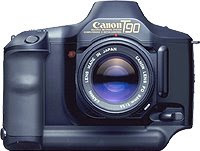
Canon T90

Released in 1986 and manufactured for only about thirteen months, the T90 represents the zenith of Canon's manual focus camera line up. The next SLR they produced was the auto focus EOS 6XX series (650 and 630). Everyone was going auto focus in the mid to late '80s, so Canon changed their lens mount and left thousands of Canon shooters standing with their zoom in their hand; none of their manual focus FD and FL lenses would mount on these new EOS cameras which raised a bit of a stink among Canon loyalists. A lot of people to this day can't believe Canon did and got away with it. I can't even imagine what it must have been like at the time to have thousands of dollars invested in lenses and camera bodies, only to have your camera company of choice turn your world upside down by basically saying, "If you want one of our new cameras, you'll need to drop some coin on new lenses, too. It'll be worth it...they're newer...better...faster...."

What makes the T90 so special? First, you have to consider its features in the proper context: This camera was introduced in 1986 when cameras, by comparison, were square and looked like your dad's SLR. Canon brought in a German industrial designer named Luigi Colani, known for his work designing sports cars for Porsche, Ferrari and Lamborghini. Gone are the squared off edges and corners, replaced by smooth curves that invite you to pick up the camera and use it. The deep hand grip and LCD display on the camera's right shoulder first appeared on the T90 and became the template for Canon's SLR design from that day forward.

But, looks aside, the T90 made several leaps forward regarding the features Canon packed into their cameras. Up to this point, most SLRs they made had horizontal focal plane shutters that would only sync with a strobe unit at 1/60 of a second (the earlier T70 does sync at 1/90). The T90's precision metal vertical-travel focal plane shutter allows flash sync at 1/250—now the industry standard on just about all pro-level SLRs. If you don't shoot with strobes, this number means nothing to you, so I'll just say it's pretty damn cool.


Additionally Canon packed in several other features like three metering modes: full frame averaging, center-weighted averaging, and a 2.7 degree spot meter. They also loaded it with a built-in motor drive that advances the film at one of two user-selected speeds: Low at 2 frames per second or High at a blistering 4.5 fames per second. Most consumer level digital SLRs on the market today still can't touch the T90's highest frame rate.

In their efforts to appeal to the widest range of shooters possible, Canon also built the T90 with all the requisite Program and Auto shooting modes people had come to expect in their cameras at this point in time, but none of those features interest me much as I tend to shoot almost exclusively in Manual mode (save the few instances when I want to pick up the camera and grab a quick shot with no time to take a meter reading). I bought into the T90 after using my Olympus dSLR showed me how much more control I can have over my creativity with something as simple as a spot meter and a flash sync higher than 1/60. The motor drive is just gravy and not something I tend to use all that often, but it's nice to know it's there for those times when a sequence shot is the only kind of shot that will do.

I'm a couple months into shooting with the T90 and I have to say this camera is a joy to work with. It didn't get its nickname "The Tank" for no reason; it's solidly-built, has plenty of weight and when shooting with it you know you're working with a piece of precision photographic equipment. So far the images it's helped me create have been wonderful. Included here are a few images from the first shoot I did with the camera a couple days after receiving it. My sister and a good friend of ours share back to back birthdays, for which they usually combine their efforts and celebrate together with a low-level gathering of good friends new and old. This year I commandeered a corner of a spare bedroom and set up a couple fluorescent Home Depot shop lights to produce sort of a poor man's bank-o-Kino Flo ala Martin Schoeller. I went through six rolls of film over the next few hours as the set took on a photobooth vibe.....but with me deciding when to go click. I captured very cool shots of a bunch of incredible people...shots I still need to go through and edit down to the absolute best of the best, then figure out what to do from there. 11x14 prints for everyone!!!

Canon T90
The specs for these shots are: Canon T90 with a Canon FDn (New FD) 200mm f/4. I was shooting mostly Fuji Superia X-tra 400 film rated at ISO 250. This was giving me f/4 at 1/125...so I had the camera on a tripod quite low to the ground so I could crouch and shoot everyone seated in a comfy chair. I quickly ran out of the Fuji 400 and had to switch to Fuji HQ 200, which I had to shoot at 200 because I couldn't afford to go any slower with my shutter speed for fear of getting too many blurred shots as people laughed and interacted in front of my lens. Also, f/4 is the max aperture on that 200mm, so I was letting in as much light as I could. Normally I like to shoot color negative film 2/3 of a stop overexposed to open up the shadows a touch, but I couldn't do that with the Fuji 200. Shooting it at ISO 125 was out of the question. As a result, the grain is quite heavy in the three-quarter tones and shadows of the shots taken with the 200 at 200. The 400 at 250 is probably just as grainy, so what can you do? I think the 400 would be even grainier at 400. It is consumer-grade film, after all. Upon seeing these shots, I recently had someone ask me why I bother shooting with consumer-grade film and I didn't really have a good answer other than, 'It's cheap.' I don't like spending more than two dollars for a roll of film at this point in my career. A dollar a roll is even better!

2009-03-12

LumoPro LP120 - The Flash I Helped Design


OK, so it was me and a few thousand fellow memebers of the Strobist group on Flickr, but the features LumoPro built into the just-released LP120 are what everyone in the group was asking for. This new strobe is aimed squarely at followers of the small flash movement (aka the Strobist movement..the result of David Hobby's evangelical efforts, and his great legs).

The specs break down thusly (taken from MPEX.com...the only retailer I could find carrying the LP120 at the moment):

GN: 80 (True value, no EV compensation inflation, equivalent to Vivitar 285HV)
Swivel: 270 degrees
Tilt: 180 degrees
Zoom: 28mm, 50mm, 85mm
Wide Angle adapter: Yes
Sync ports: Miniphone and PC
Shoe: Standard ISO size, center pin contact, locking ring
Optical Slave: Yes, Switchable On/Off
Power Variable: 1/1, 1/2, 1/4, 1/8, 1/16, 1/32
Power: 4 AA (Alkaline or NiMh recommended)
Warranty: 2 years - International

I won't go through these line by line, but there are a few LumoPro included that really show they were listening.

First: There's no AUTO Thyristor feature on this flash. You don't need it. These things are all manual. You're in control of the amount of light coming out it, just like a studio strobe. Cool.

Second: The sync ports they built into the LP120 are exactly what needs to be included on this type of flash. Curse you Sunpak and Vivitar with your proprietary sync jacks. The PC connection has been the standard for the photo industry for how long, now? Well played LumoPro for including a PC sync. And, the inclusion of a 1/8" miniphone sync means if you're near a RadioShack, Target, WalMart, K-Mart, Fry's, CVS, Rite Aid or Walgreens and one of your sync cords dies (along with all your spares) all hope is not lost. 1/8" miniphone to miniphone cables are commonly available, commonly inexpensive and commonly the sync socket of choice on all types of wireless triggers on the market today. This means you don't have to drop thirty dollars on a proprietary sync cable that will only work with one specific kind of flash. Thirty dollars for a cable you're going to ball up and stuff into your camera bag at the end of the shoot. Thirty dollars for a cable that is going to break, eventually, no matter how good you treat it. Instead, in some dark corner of the www, you can probably find an electronic components retailer that will sell you a bag of twelve for ten bucks**.

At $130, I'm thinking the LP120 will quickly find its way into the Strobist gear bag of many a shooter seeking the zen of the small flash.

******************************************
**Disclaimer: I haven't actually contacted Ametron and asked if they sell miniphone cords in bulk, but I have been inside the place and wouldn't be at all surprised to learn they do. Cool store.

2009-03-10

Holga - The serious toy camera I was reluctant to take seriously.


I bought a Holga about eight years ago. A good friend had just started working at a now defunct dot com here in LA where he was exposed to the world of toy cameras by one of the site's designers (an incredible photographer in his own right). A pool of money was collected, many Holgas were purchased and that's how I was introduced to the Holga 120S. I quickly bought my own at Freestyle Photo a few days later but I never ran a complete roll of film through the thing.

Flash forward to February of 2009 and I finally completed a roll! I even processed the film in my sink. It had been sitting in my Holga for about three years before I finished off the last four frames a couple weeks ago.

There were some gems on there I have no recollection of taking. At some point I stuck a flash in the hotshoe and took the thing with me to a rehearsal with my band, Weed Patch. The negs were scanned using the transparency adapter on an Epson Perfection 1200U Photo.

I promised myself I'd shoot with my Holga a bit more now.

2009-03-06

Updated site and exciting film news.


Wow, it's been over a year since I posted something here. What a shame! I've actually still been shooting and working...some of which is featured on my updated website. I went with a clean, uncluttered approach with a brighter overall feel than I had previously. I'm happy with its simplicity. It lets my work speak for itself...for better or worse.

Oh yeah...photography. Right. I've been shooting a lot of film lately, forsaking my digital cameras for all but those situations where a check is waiting for me at the end. I'll spare you the digital-vs-analogue discussion because for anyone who uses both, it should be obvious where both shine and where they don't.

Early on, my biggest reason for shooting more film was simply that I never really got to know it. I've taken pictures most of my life–working to achieve more professional results over the past four years—and I didn't want to take my new-found enthusiasm to the digital world without getting to fully know what film has to offer. I'm glad I did this because I've really grown to love film, specifically color negative film. The tonal range you can squeeze onto a frame of color neg film is a beautiful thing. I know you can get into the HDR (High Dynamic Range) thing with a digital camera and build images that cover an incredible tonal spectrum, so my argument isn't that it's impossible to do this with a digital camera, but I will argue that it's impossible to do it in a single frame on a digi cam. HDR images are combination of as many as three or four images, taken at different exposure values, then combined with computer software to produce an image with a spectrum of tones from highlight to shadows that digital cameras are incapable of capturing with a single click of the shutter. Print neg film isn't capable of producing this range of tones, either, but when you hit that sweet spot with your exposure settings, it gets close and it's quite lovely.

Kodak seems to think there's still some life left in the old film horse; they've recently released a new color neg emulsion called Ektar 100. The comparisons immediately being made are that it produces images comparable to those produced by a digital camera at ISO 100...virtually grain-free with great saturation and sharpness. Very cool. A great example of how digital cameras have changed what photographers expect in terms of image quality. I haven't shot any of this stuff yet but I'm planning on picking some up any day now. I'll post the results here.

2008-02-08

"O' Death, Won't You Spare Me O'er For Another Year?"


One of my clients (Rural Rhythm Records – a record label specializing in classic bluegrass music) asked me to come over and spend the day taking pictures for upcoming CDs releases. The owner's father-in-law, Joe, is the gentlemen pictured here. He has the perfect look for the bluegrass market so we had a blast putting him in various traditional bluegrass scenarios all day....ending with him dressed as Santa Claus playing a banjo for this year's Christmas release. But, that's for another post.

This shot was done in my client's backyard where he's got a wonderful old shed that's literally about to fall over, if not for the system of 2x6 boards propping up one side. Totally cool.

Joe had the wardrobe down and we knew we wanted a "hands to God" pose for potential use on a gospel package, so I stuck Joe in the shed and got this great shot.

It's lit with a single Sunpak 333 strobe, camera right, fired through a 42" shoot-thru umbrella. The sky that day was very overcast and the sunlight was very soft and flat, so I set the strobe to fire at one stop over the ambient light. Because of the angle of the flash to the subject, I knew I wasn't going to get any harsh shadows on his face, but I wanted a nice aggressive fall off to black in the space behind him. Seemed to work out perfectly.

The image has been colorized in Photoshop to give a vintage, Depression-era feel.....in tune with the look of the great Coen Bros. movie O' Brother Where Art Thou?